Something changes.
THE GAME
Learn Python because the story gives you a reason to need it.
THE SYSTEM is a modern-day supernatural RPG built around real Python. You begin with simple actions and gradually gain the skills to inspect, debug, test, and modify larger systems.
STORY EVENT→ REASONREAL PYTHON→ CONSEQUENCE
PREMISE
It starts small.
An impossible interface appears on an ordinary computer. At first, all it asks for is a response.
As access increases, the problems become larger, the consequences become more physical, and understanding what the System is telling you matters as much as following its instructions.
HOW IT PLAYS
Every lesson begins with a situation.
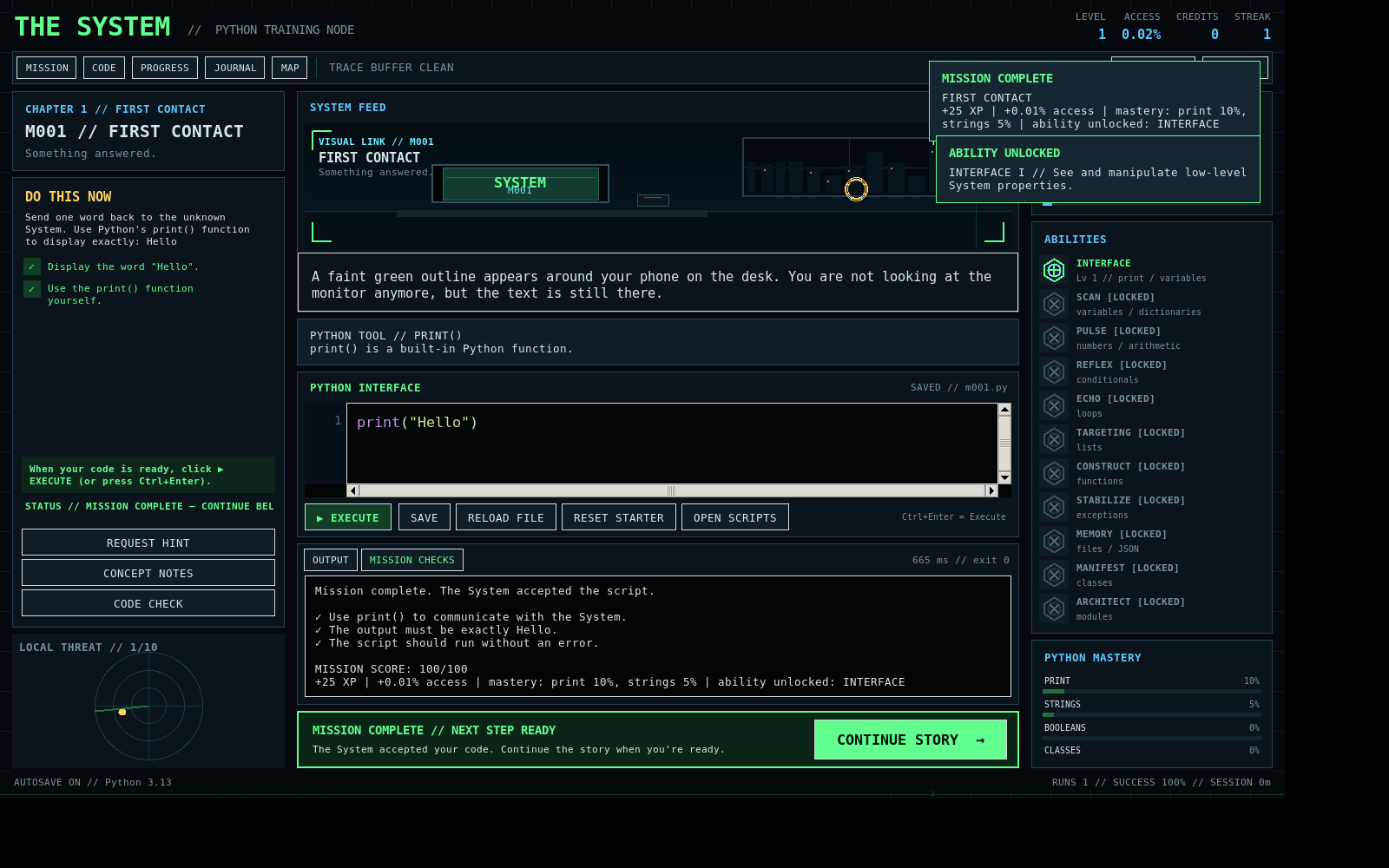
The game presents information before it presents syntax. You reason about what matters, learn the Python needed to act, run real code, and see the result.
Decide what matters.
Write real Python.
See the result.
REAL PYTHON
No fake coding language.
You work with normal Python syntax and normal Python files. The campaign gives you reasons to use variables, conditions, loops, functions, data structures, files, debugging, testing, databases, modules, APIs, and larger projects.
reading = "MOTION"
boundary_entry = True

if reading != "" and boundary_entry:
    print("MARK")
else:
    print("WAIT")
THE SYSTEM // PLAYER INTERFACEACTUAL GAME UI
LEARNING MODEL
The game teaches before it tests.
New ideas are introduced in context, practiced, reinforced, and combined. If you get stuck, TEACH ME explains the idea, hints get progressively stronger, and SHOW ANSWER lets you study a complete solution and keep moving.
Story progression stays open. Using SHOW ANSWER reduces that mission's XP reward, but it does not block the story or ability unlocks.
THE REWARD IS ACCESS
Python changes what you can do.
Progress is not only a curriculum checklist. Early chapters already turn verified Python into concrete System capability.
Current canon examples from the Chapters 1–5 build.
The reticle can identify nearby targets and expose low-level System properties after the Chapter 1 handshake is complete.
After the player verifies and explicitly registers one approved condition, the System can retain that rule after the Python session ends.
Loops become physical control: calibrate repeated output, define boundaries, and stop action deliberately instead of repeating commands by hand.
Repeated readings, route traces, and recordings can be compared without turning an unknown source into an assumed threat.
Build, select, compare, deduplicate, and organize tracked contacts while keeping TARGET separate from THREAT.
12 CHAPTERS
Capability grows with the story.
The chapter view leads with what you become able to do. Open the details when you want the Python underneath it.
01FIRST CONTACTMake the first connection.
Output, strings, variables, assignment, syntax, numbers, and arithmetic.
02AWAKENINGJudge live information.
Input, conversion, Booleans, comparisons, conditionals, and Boolean operators.
03CONTROLRepeat actions deliberately.
for, while, range, counters, accumulators, nesting, break, and continue.
04TARGETINGWork with groups of targets.
Lists, indexing, slicing, methods, tuples, sets, and iteration.
05MEMORYBuild structured knowledge.
Dictionaries, keys, values, updates, nested structures, and structured search.
06FUNCTIONSBuild reusable actions.
Parameters, arguments, returns, scope, defaults, keyword arguments, composition, decomposition, and recursion.
07STABILITYFind and survive failure.
Debugging, tracebacks, exceptions, validation, assertions, tests, and regression thinking.
08PERSISTENCEKeep evidence and state.
Files, modes, context managers, JSON, CSV, recovery, SQLite/SQL, transactions, and joins.
09MANIFESTATIONModel systems and behavior.
Classes, instances, methods, composition, inheritance, properties, class/static methods, dataclasses, and practical OOP judgment.
10ARCHITECTUREWork across systems.
Imports, modules, packages, project structure, environments, dependencies, configuration, Git concepts, APIs, and event-driven UI thinking.
11ADVANCED CONTROLHandle more with less friction.
Comprehensions, enumerate, zip, sorting, lambdas, iterators, generators, decorators, refactoring, performance, and async fundamentals.
12THE ARCHITECTEnter unfamiliar code and change it safely.
Codebase navigation, documentation research, fixtures, mocks, security review, database migration, integration, packaging, CI, and multi-file feature work.
REAL WORK
The files are yours.
Mission scripts and later workspaces remain ordinary Python files rather than being hidden inside a proprietary puzzle format. The goal is for the skills inside THE SYSTEM to transfer outside it.
DOWNLOAD THE SYSTEM