Something changes.
FIRST CONTACTREAL PYTHON // STORY-DRIVEN RPG
Something answered your computer.
You do not learn Python before the game starts. You learn it because the story gives you a reason to need it.
NO EXPERIENCE REQUIREDREAL .PY FILESSTORY DRIVES THE CODE
THE COURSE IS THE GAME
The problem comes first.
The lesson earns its place.
THE SYSTEM does not stop the RPG so a worksheet can begin. Something happens. You decide what matters. Python becomes the action. The game reacts.
Decide what matters.
Write real Python.
See what changes.
ONE EARLY MISSION
Code stops being abstract very quickly.
This is the kind of loop THE SYSTEM is built around: the story gives you data, you use Python to reason with it, and the result changes what happens next.
STORY EVENT
The phone is sitting unplugged at 13%.
THE SYSTEM reports 8 units of available charge.
13%
CANONICAL PLAYER SCRIPT // C01-M03REAL PYTHON
battery = 13
charge = 8
total_charge = battery + charge
print(total_charge)
VISIBLE CONSEQUENCE
PROGRAM OUTPUT—
Run the code to see what the player sees next.
Website replay: THE SYSTEM executes this Python in the actual game. This page replays the canonical verified result and story consequence without pretending to run a Python interpreter in your browser.
REAL GAMEPLAY
The story gets the largest space because the story is the reason to code.
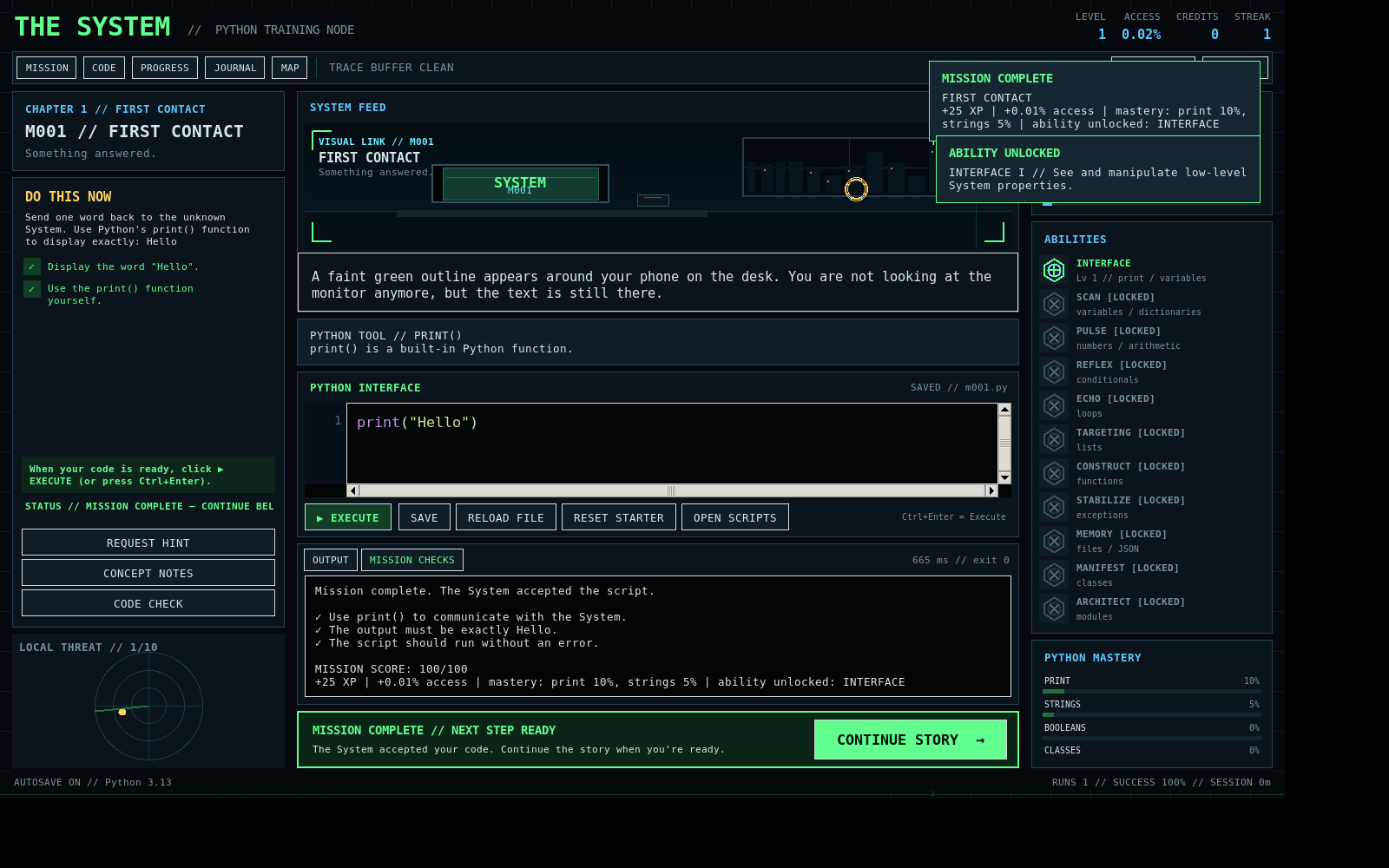
Your Python editor, Mission Checks, progression, and abilities remain close enough to use without turning the game into an IDE with a story pasted beside it.
01Story-first System Feed
Readable pacing and major moments get stronger presentation.
02Actual Python editor
Mission scripts remain normal .py files.
03Mission Checks
Failures explain what went wrong instead of only saying “incorrect.”
THE SYSTEM // PLAYER INTERFACEACTUAL GAME UI
ZERO EXPERIENCE REQUIRED
Getting stuck is part of learning.
Staying stuck is not.
The help system gets stronger only when you ask for it. You can struggle productively without being abandoned.
TRY IT
Use the story, mission directions, and starter code.
TEACH ME
Get the concept and syntax explained in plain language.
NEXT HINT
Ask for progressively stronger guidance with no XP penalty.
SHOW ANSWER
Study the complete solution and continue. Story and ability progression remain open.
PYTHON BECOMES CAPABILITY
You are not grinding syntax.
You are earning access.
THE SYSTEM ties programming progress to what the player can actually perceive and authorize. The stronger your reasoning becomes, the more capable the Interface becomes.
These are real capabilities from the current Chapters 1 through 5 build, not roadmap promises.
Complete the handshake and the perceptual Interface stabilizes. The reticle can identify the phone, window, lamp, and other low-level System properties.
Write and verify a condition, then explicitly register one approved rule that can persist after the Python session ends to highlight, light, and notify.
Use loops to calibrate repeated physical output, control release timing, and stop repeated action at deliberate boundaries.
Correlate repeated readings, recordings, and traces until patterns become stable enough to act on without confusing unknown with hostile.
Build, select, compare, and organize tracked contacts while keeping TARGET separate from THREAT. Selection is tracking, not proof of hostility.
START SMALL. END CAPABLE.
Start with one line.
End inside a real codebase.
The campaign repeats important ideas across changing situations until they stop feeling like syntax and start feeling like tools.
EXPLORE ALL 12 CHAPTERS →- 01FIRST CONTACTMake the connection.
Output, values, variables, and the first proof your code matters.
- 02CONTROLMake logic change outcomes.
Input, decisions, conditions, and repetition become tools.
- 03SYSTEMSHandle more than one thing at a time.
Collections, structured information, and reusable logic expand your reach.
- 04BUILDCreate things that persist.
Files, databases, debugging, tests, objects, modules, and larger projects.
- 05ARCHITECTEnter code you did not write.
Navigate, test, integrate, package, and modify multi-file Python systems.
HOW DEEP DOES IT GO?
Far beyond the first print().
Only after you know why the journey matters do the numbers become useful.
258CORE MISSIONS
12STORY CHAPTERS
.pyREAL PYTHON FILES
DEBUGGINGTESTINGFILESJSONSQLITE + SQLAPIsGIT CONCEPTSASYNCPACKAGINGMULTI-FILE PROJECTS
SYSTEM ACCESS
Chapters 1–5 are ready to test.
Windows v0.5.35 adds approved Option B graphics across 258 plays and subtly 3D, color-coded buttons while preserving the Chapters 1–5 story, Python lessons, and voices.